.png?width=1000&height=199&name=SG-Logo3-Transparent-1000x199px%20(1).png "www.SchoolGrowth.com")
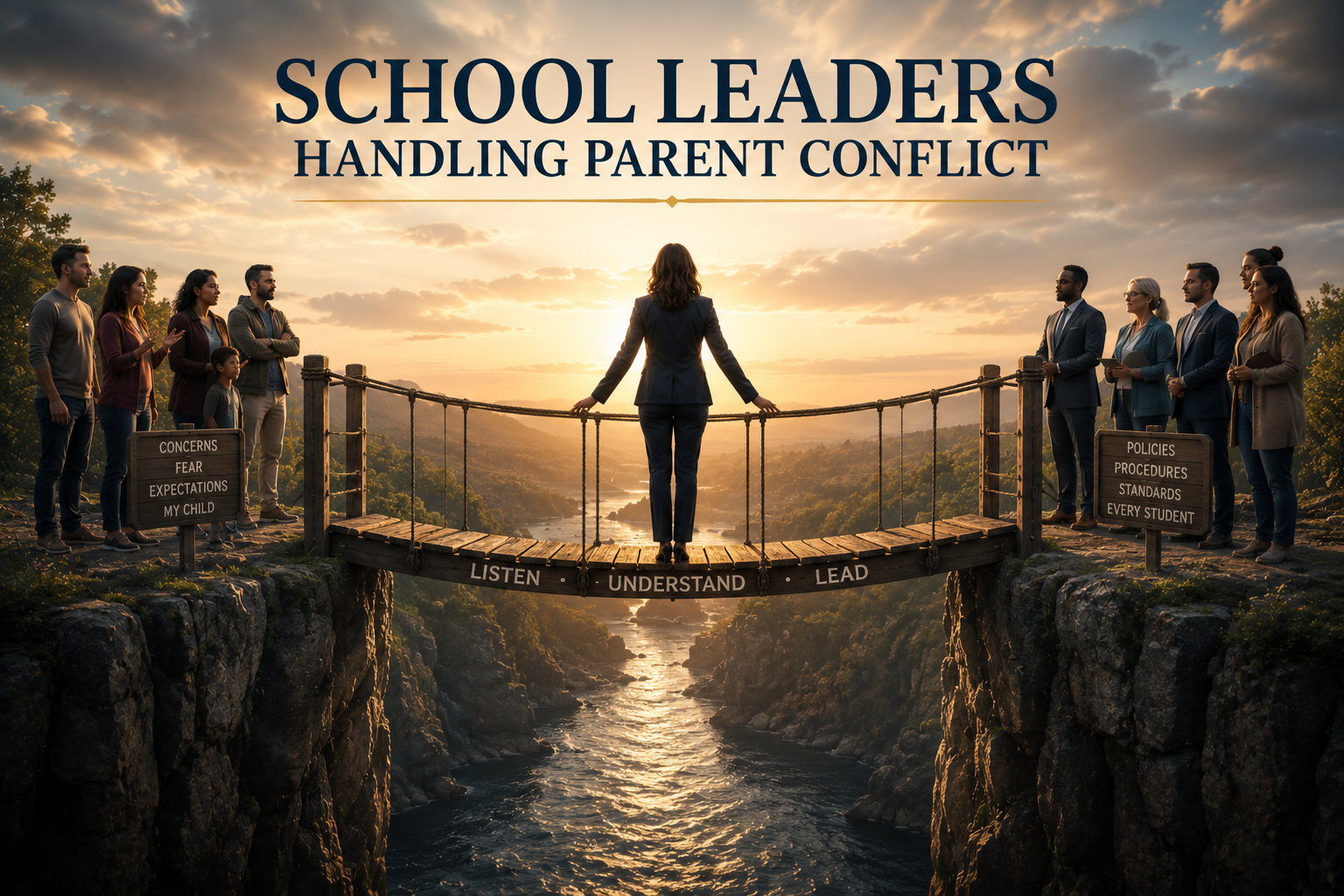
How School Leaders Handle Parent Conflict Without Losing Trust
The conversations that define your school are rarely the easy ones.
The first weeks of school are filled with excitement, anticipation, and possibility.
They are also the weeks when many school leaders receive the emails, phone calls, and office visits they dread.
A parent believes their child has been treated unfairly.
A classroom decision is questioned.
A disciplinary consequence is challenged.
A social media post has already escalated the situation before anyone inside the school has had a chance to respond.
These moments often become defining moments for trust.
Not because conflict is unusual.
Because how school leaders handle parent conflict often determines whether families leave feeling heard or dismissed.
Most School Leaders Were Never Taught This
One of the greatest gaps in educational leadership isn’t curriculum.
It isn’t budgeting.
It isn’t compliance.
It’s communication.
Most principals, assistant principals, instructional coaches, teachers, and front office staff receive very little formal training on school parent communication, especially when emotions are high.
Instead, they’re expected to learn through experience.
Unfortunately, experience can be expensive.
Without training and practice, it’s easy to walk into a difficult parent conversation already emotionally activated.
Under stress, our brains naturally shift into protection mode. We begin listening for evidence that we’re being blamed instead of listening to understand. We rehearse our response before the other person has finished speaking. We defend our intentions instead of becoming curious about their experience. We become emotionally dysregulated, even when we’re trying to remain professional. None of this makes us bad communicators. It makes us human. But without training and practice, our instincts often work against the very trust we’re trying to build.
You may find yourself:
- Assuming you already know what the parent is going to say.
- Feeling pressure because the parent is influential or well-connected.
- Worrying about enrollment, reputation, or funding.
- Rushing toward agreement simply to make the conflict disappear.
None of those responses are unusual.
They’re human. We all have them.
But they’re rarely the responses that build long-term trust.
Why Difficult Parent Conversations Escalate
When parents come to school upset, they’re often carrying more than the issue itself.
They’re carrying fear.
Fear that their child isn’t safe.
Fear that they aren’t being heard.
Fear that their child will fall behind.
Fear that something important has been missed.
School leaders often arrive carrying their own fears.
Fear of negative publicity.
Fear of losing a family.
Fear of legal implications.
Fear of another complaint landing on the head of school or superintendent’s desk.
When both people enter a conversation led by fear instead of curiosity, conflict almost always grows.
The TRUST Response
After more than 20 years in schools, I teach leadership teams that communication is a skill that can and should be practiced long before conflict occurs.
One framework I often use is the TRUST Response.
T: Take the concern seriously.
Parents don’t expect schools to be perfect.
They do expect to know that someone is listening.
Taking a concern seriously doesn’t mean deciding who’s right.
It means demonstrating that the concern matters enough to be understood.
R: Recognize the emotion without prematurely conceding.
This is one of the most misunderstood parts of building parent trust.
You can acknowledge someone’s feelings without admitting wrongdoing.
Instead of saying:
“You’re right. We shouldn’t have done that.”
Try:
“I can understand why that would be upsetting as a parent.”
One validates emotion.
The other accepts responsibility before the facts are known.
Those are not the same thing. The difference is subtle, but it matters.
U: Understand the facts and the underlying fear.
Good leaders investigate two questions.
What happened?
What is this parent most afraid of?
Often the second question matters just as much as the first.
A complaint about homework may actually be anxiety about a struggling learner.
A disagreement about discipline may actually be fear that a child is being labeled.
When leaders become curious instead of defensive, conversations change.
S: State what can and cannot happen.
Clear expectations reduce conflict. I continually come back to “clarity is kindness.” As Brené Brown puts it, “Clear is kind,” and it holds true with parent communication.
Parents appreciate honesty more than vague promises.
Explain:
- What the school can investigate.
- What policies guide decisions.
- What confidentiality laws prevent you from sharing.
- What options remain available.
Note that clarity and transparency are not the same thing. You can’t share everything with a parent because the law doesn’t allow it, but you can explain the law and what you are allowed to share.
Clarity builds credibility with parents, staff, and students.
T: Tell them what happens next.
One of the biggest frustrations for families is uncertainty.
Instead of ending with:
“We’ll look into it.”
End with:
“I’ll speak with the teacher this afternoon. I’ll review the information tomorrow morning, and I’ll call you by 3:00 p.m. on Thursday with an update, even if I don’t yet have every answer.”
People handle waiting much better when they know what they’re waiting for.
Parents will leave happier when they know what you are going to do and when you are going to get back to them. Put the follow-up to the parent on your calendar immediately. Don’t move to the next meeting or call first. If you miss the follow-up, you have lost your reliability and credibility.
Five Distinctions Every School Leader Should Remember
One reason parent conflict in schools becomes so difficult is because leaders confuse concepts that are actually very different.
Listening is not agreeing.
You can fully hear someone without changing your position.
People often become less argumentative once they genuinely feel heard.
Empathy is not surrendering authority.
Being compassionate doesn’t require abandoning school expectations or policies.
Strong leaders can be both kind and firm. Everyone should be given dignity, even when they are going to have to face consequences.
Clarity is not sharing confidential information.
Parents deserve honesty.
That doesn’t mean discussing another student’s discipline, staff personnel matters, or confidential records.
Professional boundaries actually protect trust.
Responsiveness is not immediate resolution.
Families deserve timely communication.
They don’t always deserve an instant answer.
Some situations require investigation before decisions can responsibly be made.
Intent is not impact.
Schools often explain what they meant. Parents are trying to explain what they experienced. Both matter.
A leader who focuses only on intent may unintentionally dismiss the parent’s experience. A leader who focuses only on impact may overlook important context.
The goal isn’t to argue about whose perspective is correct. It’s to acknowledge the impact, understand why it happened, and work toward a better outcome. In schools, as in any service relationship, the impact matters even when the intent was good.
Why Training Matters
|
Communication is a leadership skill, not a personality trait. |
Communication under pressure is a practiced leadership skill that can be learned, strengthened, and improved over time.
Athletes practice before the game. Pilots train before emergencies. Healthcare teams rehearse difficult scenarios before patients arrive.
Yet many educators are expected to navigate emotionally charged conversations with no structured practice at all.
That isn’t because educators don’t care. It’s because most preparation programs simply don’t spend enough time helping leaders, teachers, and staff develop these skills.
The result is that difficult conversations become reactive instead of intentional.
Building a School Culture That Handles Conflict Well
Excellent principal parent communication isn’t created one conversation at a time. It’s built across an entire organization.
Every adult who answers the phone...
Greets families in the front office...
Responds to an email...
Leads a conference...
Or addresses a concern...
Shapes the school’s reputation.
Parents don’t experience communication from one person. They experience communication from the entire school.
Every adult who interacts with families represents the school’s culture. One difficult conversation handled well can strengthen trust. One handled poorly can undo months of relationship-building.
Yet we often wonder why teachers hesitate to call parents or why parent-teacher conferences don’t always go well. The answer is surprisingly simple. Most teachers have never been taught how to have these conversations.
We train them on the information they need to communicate. We rarely train them on the communication itself: how to listen, regulate emotions, ask thoughtful questions, de-escalate tension, or respond when emotions rise. Like any other professional skill, effective communication improves with practice.
That’s why communication training should never be reserved only for principals.
Teachers, assistant principals, counselors, office staff, and district leaders all benefit from learning how to listen effectively, regulate emotions, ask better questions, set appropriate boundaries, and navigate conflict with confidence.
The Goal Isn’t Fewer Complaints
Schools that are doing remarkable work still receive complaints.
The goal isn’t to eliminate conflict.
The goal is to respond in ways that strengthen trust instead of weakening it.
Parents may not always agree with a school’s decision.
But they are far more likely to continue trusting a school when they believe they were heard, respected, treated fairly, and kept informed throughout the process.
That kind of trust doesn’t happen by accident.
It happens because leaders prepare for difficult conversations before they ever have them.
|
Trust isn’t built when everything goes right. It’s built when relationships are tested. |
Every school will experience parent conflict.
The schools families remember aren’t the ones that never faced difficult conversations.
They’re the ones that handled those conversations with professionalism, empathy, clarity, and consistency.
How School Growth Can Help
At School Growth, we provide professional development for school leaders, teachers, and support staff on navigating difficult parent conversations with confidence and professionalism.
Our interactive workshops go beyond theory. Teams practice real-world scenarios, learn evidence-based communication strategies, strengthen emotional regulation under pressure, and develop consistent approaches that build parent trust while protecting school culture.
Whether you’re preparing for a new school year or strengthening leadership capacity across your district, communication is one of the highest-return investments you can make.
Because the conversations that are hardest to have are often the ones that matter most.