.png?width=1000&height=199&name=SG-Logo3-Transparent-1000x199px%20(1).png "www.SchoolGrowth.com")
It is 10:47 on a Tuesday night. A mother sits at her kitchen table, laptop open, a cup of tea going cold beside her. She has fourteen browser tabs open: school websites, review platforms, a neighborhood Facebook group, and a virtual tour she has now watched twice. Her son starts kindergarten in the fall, and somewhere between the third website and the seventh review, her questions changed. She is no longer comparing class sizes or bell schedules. She is asking something much harder to answer and much more important: Can I trust these people with my child?
Every enrollment decision, at every school, eventually arrives at that question. Yet most schools never plan for it. They plan for the website. They plan for the open house. They plan for the ad campaign and the yard signs and the social media calendar. Then they wonder why inquiries do not become applications, why tours do not become enrollments, and why families who seemed enthusiastic in October quietly disappear by January.
“Every enrollment decision eventually arrives at one question: Can I trust these people with my child?”
The answer is not that these schools are marketing poorly. It is that marketing was never the whole job. Marketing is simply the first stage of a much longer journey, and the schools that grow, year after year, are the ones that understand where that journey actually leads.
The Real Question Behind Every Enrollment Decision
Choosing a school is unlike almost any other decision a family makes. It is not a purchase; it is an act of entrusting. Parents are not selecting a product. They are selecting the adults who will shape their child's days, influence their child's confidence, and stand beside their child during some of the most formative years of life.
That is why school enrollment cannot be understood through the logic of consumer marketing alone, even though schools increasingly borrow its tactics. A family can be fully aware of your school, impressed by your brand, and still walk away, because awareness and admiration are not the same thing as trust. Understanding how families move from noticing a school to entrusting a school is the single most valuable insight an enrollment-focused leader can have.
After years of working with school leaders across every sector, I have come to describe that movement in five stages. I call it The Enrollment Trust Framework.
Introducing The Enrollment Trust Framework
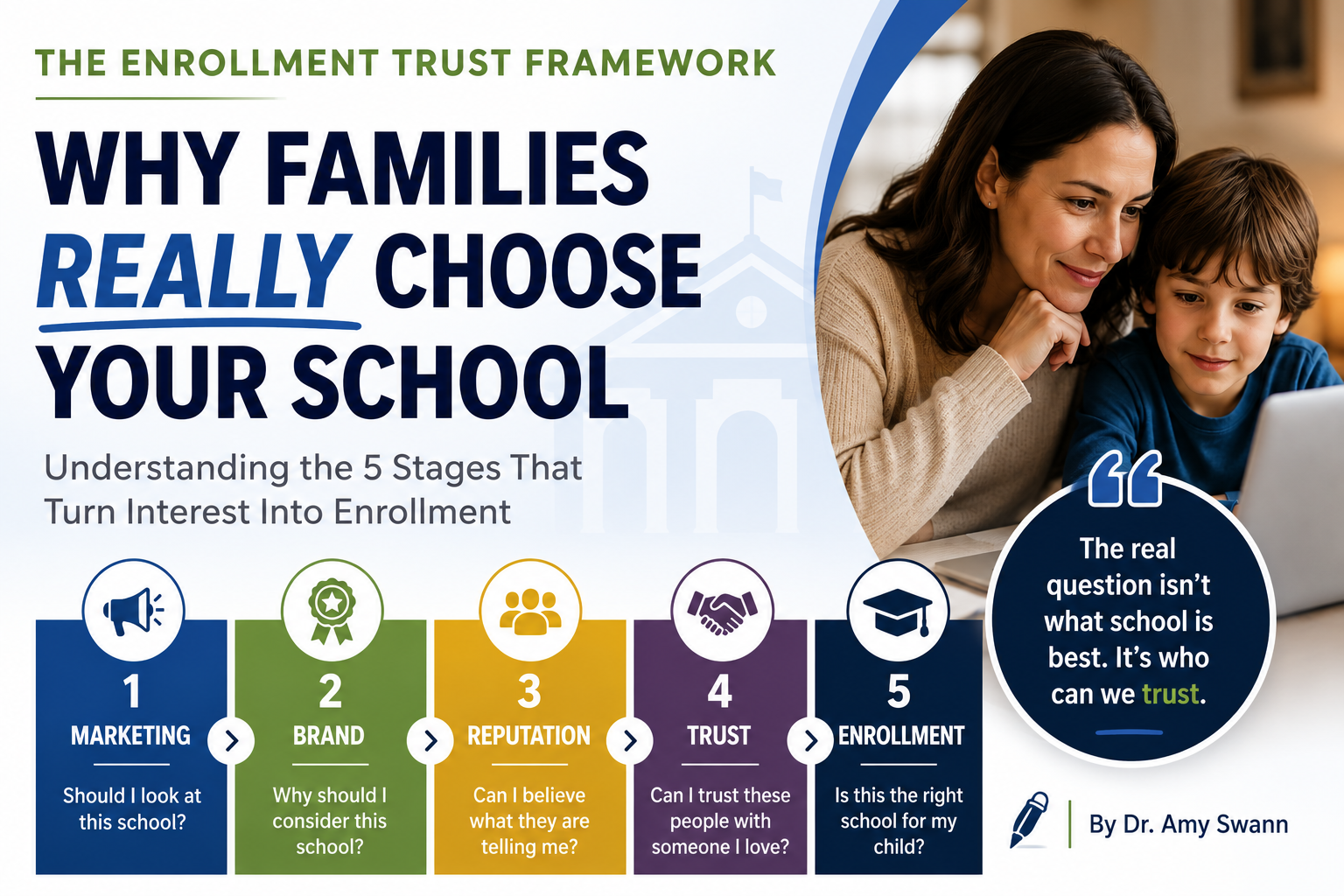
The Enrollment Trust Framework describes the journey every family travels on the way to saying yes to a school:
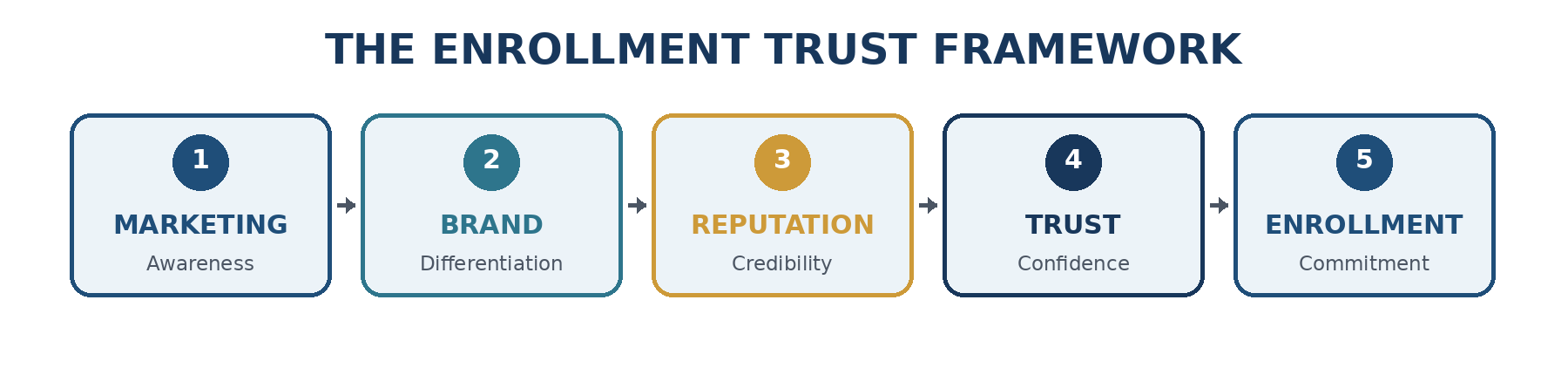
Marketing creates awareness. Brand creates differentiation. Reputation creates credibility. Trust creates confidence. Enrollment creates commitment.
|
Stage |
The Question Families Are Asking |
Leadership Focus |
|
Marketing |
Should I look at this school? |
Awareness |
|
Brand |
Why should I consider this school? |
Differentiation |
|
Reputation |
Can I believe what they are telling me? |
Credibility |
|
Trust |
Can I trust these people with someone I love? |
Relationships & Experience |
|
Enrollment |
Is this the right school for my child? |
Outcome |
Each stage answers a different question in the mind of a family, and each stage demands a different focus from school leadership:
Marketing → Awareness
Brand → Differentiation
Reputation → Credibility
Trust → Confidence
Enrollment → Commitment
The first version describes what schools do. The second describes what families experience. Both matter, because enrollment strategy fails precisely at the gap between the two: when a school believes it is communicating excellence while a family is still waiting to feel confidence.
The Psychology of How Families Decide
Walk through the framework from the family's side of the table, and the logic of each stage becomes clear.
Marketing creates awareness
A family cannot choose a school it has never heard of. Marketing, in all its forms, from digital advertising to word of mouth to the banner outside your building, exists to answer one modest question: Should I look at this school? That is all marketing can do, and it is enough. The mistake is asking marketing to do more: to persuade, to reassure, to close. Marketing opens the door. It cannot walk anyone through it.
Brand creates differentiation
Once a family is aware of you, they immediately place you alongside every other option they are considering. Your brand is your answer to the question: Why should I consider this school over the others? A brand is not a logo or a tagline. It is the clear, consistent articulation of what your school specializes in, what makes it distinct, who it serves best, and what families can expect to experience there that they will not find at the school down the road.
Reputation creates credibility
Here the family stops listening to you and starts listening to everyone else. Reviews, neighbors, alumni, current parents, teachers who used to work for you: this chorus answers the question your own materials cannot: Can I believe what they are telling me? Reputation is the public record of whether your brand promises are kept. When brand and reputation align, credibility takes root. When they diverge, families always believe the reputation.
Trust creates confidence
Trust is where the decision becomes personal. A family can find you credible in the abstract and still hesitate, because the real question has changed again: Can I trust these people with someone I love? Trust is built almost entirely through human interaction: the admissions call that felt unhurried, the teacher who knelt to greet a nervous child by name, the tour guide who answered a hard question honestly instead of smoothly. No campaign can manufacture these moments. They are the product of culture, and families can sense culture within minutes of walking through your doors.
Enrollment creates commitment
Enrollment is what happens when every previous stage has done its work. The family that signs the contract or submits the registration is answering the final question, Is this the right school for my child?, with the confidence that only accumulated trust makes possible. This is why enrollment cannot be engineered at the point of decision: trust drives enrollment, and by the time a family reaches the decision, the decision has largely been made.
Excellence Isn't a Differentiator
There is a hard truth buried in the brand stage of the framework, and it deserves its own moment: excellence is not a differentiator.
“Excellence is not a differentiator. Distinctiveness is.”
Visit the websites of any ten schools in your region, of any type, and you will find the same vocabulary: excellent academics, caring teachers, a warm and welcoming community, preparing students for success. Every school says these things. Because every school says them, no family can use them to choose. Claims of excellence are not the ceiling of school marketing; they are the floor. They are the price of admission to the conversation, not a reason to win it.
What families can actually use is distinctiveness: the specific, concrete, verifiable things that are true of your school and not true of the schools nearby. The way your middle schoolers run a real business each spring. The fact that your kindergarten teachers make home visits before the first day. The alumni who return, decade after decade, to mentor current students. Distinctiveness gives your brand substance, gives your reputation something specific to confirm, and gives families something real to trust. If your school removed its name from its homepage and any other school could claim the remaining text, the work of differentiation has not yet been done.
Strengthening Every Stage: A Practical Guide
The power of The Enrollment Trust Framework is diagnostic. When enrollment falters, the framework tells you where to look. Here is what strengthening each stage looks like in practice.
Strengthen marketing (awareness)
Audit where prospective families in your community actually spend attention, and meet them there rather than where you have always advertised.
Measure inquiries and first-touch sources, not impressions. Awareness only matters if it produces a first conversation.
Make the next step effortless: one clear call to action on every page, every ad, every mailer.
Strengthen brand (differentiation)
Name three things that are true of your school that no nearby school can honestly claim. If leadership cannot agree on them, that is the work.
Replace generic language such as excellence, community, and rigor with specific evidence and stories that show those qualities in action.
Say who your school serves best. Clarity attracts the right families and gracefully releases the wrong ones.
Strengthen reputation (credibility)
Give current families, alumni, employees, and community partners natural opportunities to share specific experiences publicly. Reputation grows when genuine satisfaction is given a channel.
Respond to criticism with honesty and composure. How a school handles a hard review tells families more than the review itself.
Close the gap between promise and experience. Every brand claim your school makes should be one a current parent would confirm unprompted.
Strengthen trust (relationships and experience)
Map every touchpoint a family experiences from first inquiry to first day of school, and ask of each one: does this moment build trust or spend it?
Train everyone who meets prospective families, including front-office staff, coaches, and bus drivers, because families are always watching how your adults treat people.
Choose honesty over polish. Admitting what your school is still working on builds more trust than a flawless pitch ever will.
Strengthen enrollment (commitment)
Remove friction from the final step: simplify forms, communicate timelines clearly, and follow up personally rather than automatically.
Treat the yes as a beginning. The weeks between enrollment and the first day of school set the tone for retention.
Track the reasons families decline, delay, or fail to complete enrollment, so leaders can distinguish a process problem from a trust problem.
Why the Framework Doesn't End at Enrollment
Here is what makes this framework larger than admissions season: the journey does not end when a family enrolls. It repeats, every single year, inside your building.
Current families re-ask every question in the framework annually. Is this still the right school for my child? is simply the trust question, asked again with a year of evidence in hand. Retention is enrollment, renewed. And families whose trust deepens over time become something more valuable than customers: they become advocates. They write the reviews that build your reputation, tell the stories that carry your brand, and provide the word of mouth that often becomes a school's most trusted and influential form of marketing.
“Retention is enrollment, renewed.”
This is the quiet elegance of the framework: its final stage feeds its first. Trust earned inside the school becomes awareness, differentiation, and credibility outside it. Schools that understand this stop treating enrollment as a season and start treating it as a culture.
Leadership Reflection
|
Use these questions with your leadership team:
|
The Human Side of School Leadership
A word for the leaders reading this with an enrollment target hanging over them: the pressure is real, and it is heavier than most people outside your office understand. Enrollment numbers carry budgets, salaries, programs, and sometimes the survival of the school itself. It is easy, under that weight, to start reducing families to leads, pipeline numbers, and conversion rates, because that is the language the pressure speaks.
But remember the mother at her kitchen table. She is not a lead. She is a parent trying to make one of the most consequential decisions of her family's life, at eleven o'clock at night, with nothing to go on but what your school has shown her and what others say about you. The Enrollment Trust Framework works not because it is clever, but because it takes her seriously. Every stage of it is simply a way of honoring what she is actually going through.
You are not marketing a product. You are stewarding trust. Leaders who hold onto that truth make better enrollment decisions, and they sleep better too.
“You are not marketing a product. You are stewarding trust.”
Frequently Asked Questions
What is the Enrollment Trust Framework?The Enrollment Trust Framework, developed by Dr. Amy Swann, is a five-stage model explaining how families choose schools: Marketing → Brand → Reputation → Trust → Enrollment. Each stage answers a different question families ask, from initial awareness to final commitment, and shows school leaders that enrollment is the outcome of accumulated trust, not the result of marketing alone. |
Why isn't marketing enough to grow school enrollment?Marketing creates awareness, but awareness alone does not convince a family to entrust a school with their child. Families move through four additional stages, brand, reputation, trust, and finally enrollment, before committing. Schools that invest only in marketing generate inquiries that stall, because the deeper questions of credibility and trust remain unanswered. |
What is the difference between a school's brand and its reputation?A school's brand is what the school says about itself: its identity, promises, and points of distinction. Its reputation is what others say about the school: parents, students, alumni, and the wider community. Brand creates differentiation; reputation creates credibility. When the two align, families believe the school. When they conflict, families believe the reputation. |
How do schools build trust with prospective families?Trust is built through consistent human experiences rather than messaging: unhurried admissions conversations, honest answers to hard questions, staff who know children by name, and a visible match between what the school promises and what families observe. Every touchpoint from first inquiry to first day either builds trust or spends it. |
Does the Enrollment Trust Framework apply to retention as well as recruitment?Yes. Current families re-ask the framework's questions every year, so retention is enrollment renewed. Families whose trust deepens become advocates who strengthen the school's reputation and marketing through reviews and word of mouth, which means the framework's final stage continuously feeds its first. |
Which types of schools can use this framework?The framework can be used by schools across sectors: district, charter, independent, faith-based, magnet, and microschools. Because it describes how families make trust decisions rather than how any particular sector markets itself, it is especially relevant wherever families have meaningful choices among schools or programs. |
A Final Thought: The Forest, Not the Tree
Schools under enrollment pressure are often tempted to plant a single fast-growing tree: a new campaign, a rebrand, or a viral moment. But sustainable enrollment does not grow from one tactic. It grows from an ecosystem in which marketing, brand, reputation, relationships, and experience reinforce one another.
Marketing may draw a family to the edge of your school community. Only the health of everything they encounter there will convince them to stay. Tend the whole system, because families can tell the difference.
The families sitting at their kitchen tables tonight, tabs open and tea going cold, are looking for a school they can trust.
— Dr. Amy Swann
|
TURN THE FRAMEWORK INTO ACTION Use The Enrollment Trust Framework with your leadership team to identify where families are losing confidence and what your school can strengthen next.
|